The Story of Beach Avenue:
901–931, and the Living History of 931 Beach Guest House
Long before Beach Avenue became one of the most photographed oceanfront streets in America, this stretch of land between the sea and the town was already destined for prominence.
Cape May is recognized as America’s oldest seaside resort, welcoming visitors as early as the mid-1700s. By the 1800s, it had become the summer playground of presidents, industrialists, and wealthy families from Philadelphia, New York, Baltimore, and Washington, D.C.
The Victorian Rebirth After the Great Fire
In 1878, the Great Fire of Cape May destroyed much of the town. What followed was one of the most extraordinary rebuilding efforts in American resort history.
Between 1879 and the early 1900s, Cape May was rebuilt almost entirely in the Victorian style—Queen Anne, Stick Style, and Italianate architecture. It is this rebuilding era that gave Cape May its famous architectural unity and led, decades later, to its designation as a National Historic Landmark City.
During this golden rebuilding period, Beach Avenue became the town’s most prestigious address.
The Creation of the Oceanfront Cottage Row (901–931)
While the massive resort hotels rose just inland, the oceanfront stretch from 901 to 931 Beach Avenue was developed primarily as private summer “cottages” for wealthy families. These homes were designed for long seasonal stays and built to maximize ocean breezes, natural light, and cross-ventilation long before air conditioning existed.
By the 1880s through the early 1900s, this entire stretch had become a continuous and architecturally harmonious oceanfront streetscape.
A Front-Row Seat to Cape May's Golden Age
From the porches of these homes, families would have watched horse-drawn carriages rolling down Beach Avenue, ladies strolling with parasols, gentlemen in straw boater hats, and children playing along the promenade. These houses were not just residences—they were part of Cape May’s social stage.
The 20th Century: From Private Estates to Guest Houses
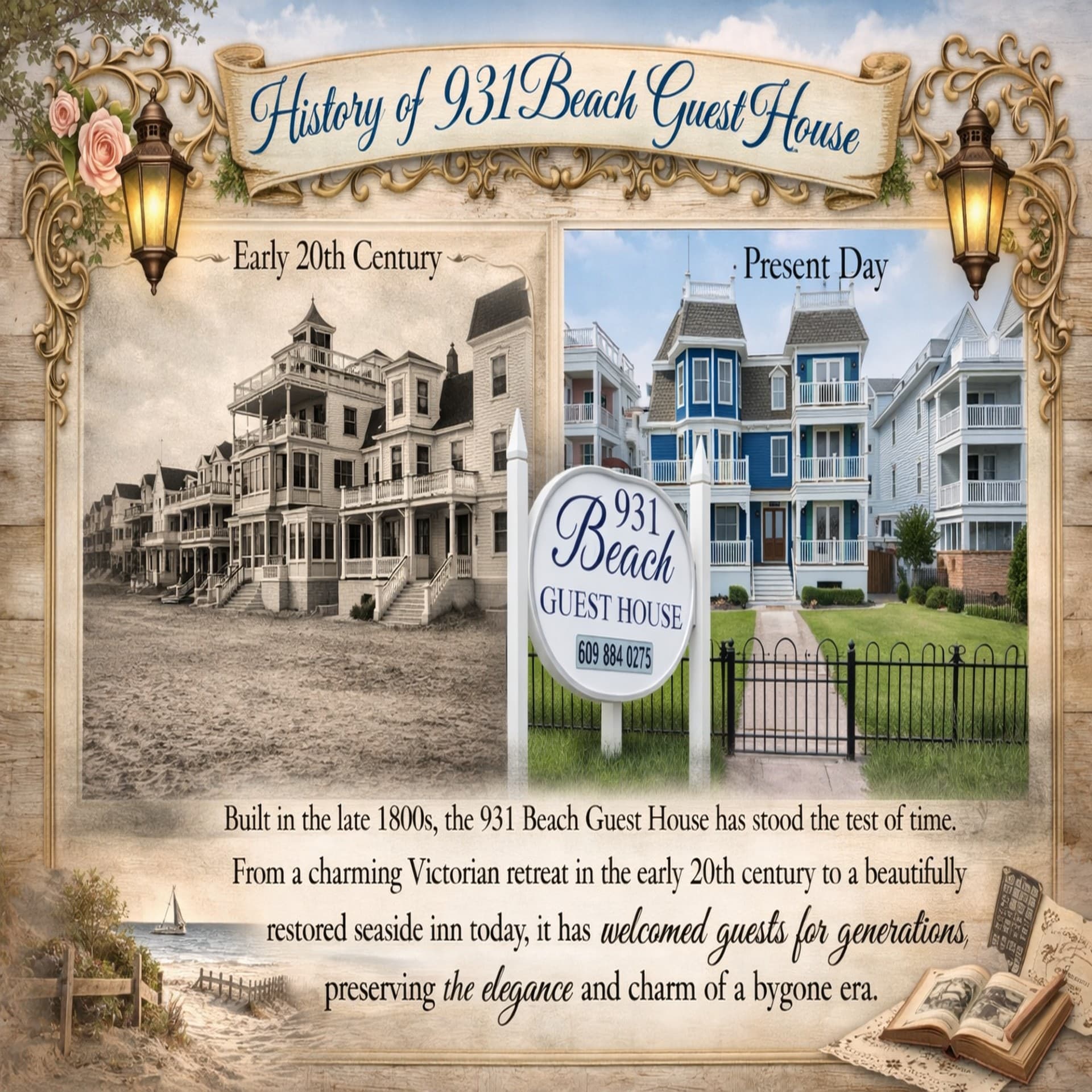
By the 1920s through the 1950s, travel patterns changed. Many of these large private homes were gradually converted into boarding houses, guest houses, and inns. Yet their purpose never changed: to welcome visitors to Cape May.
Preservation and the Victorian Renaissance
In the 1970s, Cape May was officially designated a National Historic Landmark City, sparking a massive preservation movement. Instead of being demolished, the Beach Avenue homes were restored and carefully modernized, preserving one of the largest collections of Victorian buildings in the United States.
931 BEACH: A New Legacy Begins
Nearly 20 years ago, the current owners began a new chapter. With vision and care, they transformed 931 into a beautifully updated guest house. One of their most defining contributions was changing the home to its now-iconic blue exterior—making it one of the most photographed homes in all of Cape May.
More Than a Business — A Family Home
For the owners, 931 was never just a business. It was where they spent summers with their two boys, watched sandy footprints run up the steps, and built traditions that lasted for years. As their boys grew, so did the mark they made on 931 and on Cape May itself.
20 Years of Stewardship
This May, the owners celebrate 20 years of ownership—two decades of restoration, care, and heartfelt hospitality.
A Living Chapter in a 150-Year Story
The homes of 901 to 931 Beach Avenue tell the story of Cape May’s rise as America’s original seaside resort. But 931 Beach Guest House tells something more: a story of family, legacy, and a house that continues to welcome new generations to the sea.